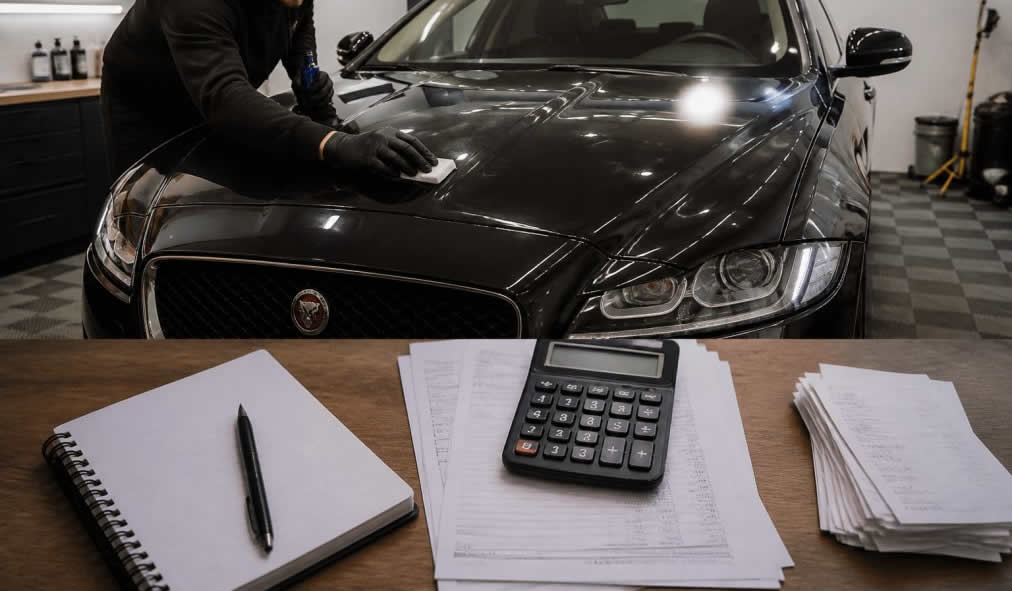
Ceramic coating is a liquid polymer applied to a vehicle’s exterior that bonds chemically with the factory paint, creating a semi-permanent protective layer. Unlike a traditional wax or sealant, it does not wash away or require monthly reapplication. That permanence is precisely why the upfront cost is higher and why the preparation work matters so much.
Several factors combine to determine the final price of any ceramic coating job. No two vehicles are identical, and no two coating grades offer the same level of protection or longevity.
Vehicle Size and Panel Complexity
Larger vehicles require more product and more time. A compact hatchback will always cost less to coat than a full-size SUV or an extended-wheelbase saloon, simply because there is more surface area to prepare, prime, and coat. Panel complexity adds another layer of cost: deeply sculpted bodywork, intricate door handles, complex grille designs, and wide sill sections all slow the application process and demand greater precision.
Motorbikes present their own set of challenges. Exposed engine casings, frame sections, and bodywork panels are harder to access than a car’s flat door skins, and the coating must be applied carefully around heat-sensitive components.
Coating Grade and Product Tier
Not all ceramic coatings are the same product. Entry-level consumer coatings are available from motor factors and high-street retailers, but professional-grade coatings from specialist manufacturers are formulated differently: higher solids content, stronger chemical bonding, and longer projected lifespans. Professional-grade products are typically only available to trained and accredited applicators, which is part of why professional ceramic coating cost sits above what a DIY kit costs at the counter.
The coating tier you choose directly affects durability. A lower-grade product applied perfectly will still underperform a higher-grade product applied with equal care. For prestige and performance vehicles where paint protection is a genuine investment, specifying the right product tier is not an area to economise on.
| Factor | Effect on Cost | What to Ask |
|---|---|---|
| Vehicle size | Larger = higher cost | Confirm vehicle class at booking |
| Panel complexity | More sculpting = more time | Discuss bodywork design upfront |
| Coating product tier | Higher grade = higher cost | Ask which product line is being used |
| Paint condition | Poor condition = prep cost | Request a paint inspection first |
| Number of coats | More layers = more material | Clarify how many coats are included |
Paint Correction Cost and Why It Comes First
Most guides treat paint correction as an optional add-on. This is the part most people get wrong, and it is worth addressing directly.
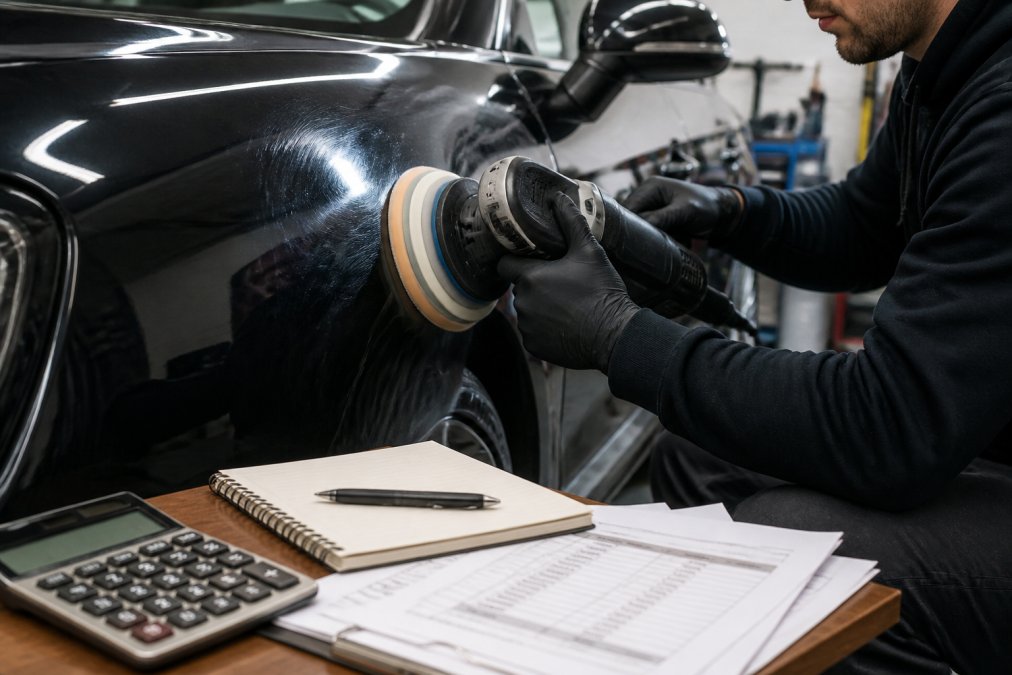
Paint correction is the process of mechanically removing surface defects from a vehicle’s clear coat: swirl marks, fine scratches, water spots, and oxidation. It is carried out using machine polishers and abrasive compounds, working through progressive grades until the paint surface is optically flat and defect-free. According to the Detailing Industry Association’s guidance on paint care, paint correction is considered a prerequisite for any long-term protective coating application.
Paint correction cost varies with the severity of the defects and the number of polishing stages required. A single-stage polish removes lighter swirling and improves gloss. A two-stage or multi-stage correction addresses deeper scratches and more significant marring. The time investment is substantial: a thorough multi-stage correction on a prestige vehicle can take a full day or more before the coating work even begins.
What Paint Correction Actually Involves
The process starts with a thorough decontamination wash, followed by clay bar treatment to remove bonded surface contamination. Paint depth readings are taken across panels to confirm there is sufficient clear coat to polish safely. Then machine polishing begins, working section by section across the vehicle.
This is skilled, time-consuming work. The cost reflects genuine labour and expertise, not padding. A detailer who skips or rushes this stage is not offering a better deal; they are offering a worse result.
Skipping Correction: What Happens to Your Coating
Here is the practical reality: ceramic coating is optically transparent. It does not fill scratches or hide swirl marks. It locks in whatever surface condition exists beneath it. Apply a coating over defective paint and you seal those defects permanently, making them harder to address later without stripping the coating first.
Many vehicle owners with newer cars assume their paint is in good condition. Swirl marks from automated car washes, minor wash-induced scratches, and light scuffing from everyday use accumulate faster than most people realise. A professional paint inspection before any coating application will identify what preparation is genuinely required.
Watch Out
Skipping paint correction to reduce upfront cost is a false economy. Defects sealed under a ceramic coating require the coating to be stripped before they can be polished out, adding significant cost to any future correction work.
Skipping paint correction to reduce upfront cost is a false economy. Defects sealed under a ceramic coating require the coating to be stripped before they can be polished out, adding significant cost to any future correction work.
Professional Application vs DIY Ceramic Coating
The DIY ceramic coating market has grown considerably, and consumer-grade kits are widely available. The honest comparison is not flattering to the DIY route for most vehicle owners.
Professional application differs in three fundamental ways. Product quality is the first: professional coatings are formulated to higher specifications than consumer products and are not sold retail. Application environment is the second: a professional workshop controls temperature, humidity, and contamination in ways a home garage or driveway cannot. Skill and experience is the third: correct application technique, flash times, and levelling require practice that most vehicle owners simply do not have.
Consumer-grade coatings applied at home can provide meaningful protection, but their longevity and performance ceiling are lower. They are also more prone to high spots and streaking when applied without experience, which can require significant correction to remove. For a daily driver where aesthetics are secondary to basic protection, a DIY approach is a reasonable choice. For a prestige or performance vehicle, the risk-reward calculation is different.
As Which? guidance on car care products notes, the performance gap between consumer and professional protection products is meaningful and worth factoring into any long-term maintenance plan.
Pro Tip
If you are considering a DIY coating on a vehicle you care about, at minimum have the paint professionally corrected and decontaminated first. Applying any coating over contaminated or defective paint wastes both the product and your time.
If you are considering a DIY coating on a vehicle you care about, at minimum have the paint professionally corrected and decontaminated first. Applying any coating over contaminated or defective paint wastes both the product and your time.
How Long Does Ceramic Coating Last?
How long a ceramic coating lasts depends on the product grade, the quality of application, and how the vehicle is maintained afterwards. Professional-grade coatings from reputable manufacturers are typically rated for several years of protection under normal use conditions. Consumer-grade products generally offer shorter projected lifespans.
These ratings are projections, not guarantees. A coating on a vehicle that is regularly machine-washed, parked outdoors in harsh conditions, and never maintained with appropriate products will degrade faster than the same coating on a well-maintained vehicle kept under cover. The Scottish climate, with its combination of road salt, persistent rain, and temperature cycling, is genuinely demanding on any protective coating.
The practical answer for most vehicle owners is that a professional-grade ceramic coating, properly applied and maintained, should provide meaningful protection for several years before a top-up or reapplication becomes necessary. This is substantially longer than a conventional wax or synthetic sealant, which typically requires reapplication every few months.
Key Takeaway
Ceramic coating longevity is not just a product specification, it is a function of maintenance. A high-grade coating that is neglected will underperform a lower-grade coating that is properly cared for.
Ceramic coating longevity is not just a product specification, it is a function of maintenance. A high-grade coating that is neglected will underperform a lower-grade coating that is properly cared for.
Ceramic Coating Maintenance: Protecting Your Investment
Ceramic coating maintenance is simpler than many vehicle owners expect, but it is not zero effort. The coating does not make a vehicle self-cleaning; it makes cleaning easier and more effective by reducing the adhesion of dirt, water, and contaminants to the paint surface.
The most important maintenance practice is correct washing technique. Automated car washes with rotating brushes are the single fastest way to degrade a ceramic coating, introducing swirl marks and abrasion that diminish both the coating and the paint beneath it. A proper two-bucket hand wash or a touchless wash is the appropriate method.
Beyond washing, periodic application of a ceramic-specific maintenance spray helps sustain the hydrophobic properties of the coating between professional inspections. This is a straightforward process that most vehicle owners can carry out themselves.
What to avoid is equally important. Harsh detergents, abrasive cleaning products, and anything containing wax or silicone can interfere with the coating’s chemistry. The British Standards Institution guidance on automotive surface care provides a useful reference for understanding which product formulations are compatible with polymer-based protective coatings.
A professional inspection every twelve months is worthwhile for vehicles where the coating represents a meaningful investment. This allows any areas of degradation to be addressed before they compromise the underlying paint.
Is Ceramic Coating Worth the Cost for Your Vehicle?
The honest answer is: it depends on the vehicle and how you use it.
For prestige and performance vehicles, new cars where preserving resale value matters, and vehicles exposed to demanding conditions, ceramic coating cost is straightforwardly justified. The protection it provides against UV degradation, chemical etching, minor abrasion, and contamination bonding is genuinely superior to any other surface treatment currently available at a comparable price point. Paint damage on a prestige vehicle is expensive to correct; protection is cheaper than repair.
For older vehicles with significant pre-existing paint defects, high paint correction cost may make the total investment harder to justify unless the owner intends to keep the vehicle long-term. The coating itself will not improve the paint’s condition; it will preserve whatever condition exists after correction.
The comparison with cheaper alternatives is worth making directly. A quality synthetic sealant costs far less than a professional ceramic coating, but requires far more frequent reapplication and offers meaningfully less chemical and UV resistance. Over a three-to-five year period, the total cost of repeated sealant applications, including the time and product cost, often approaches or exceeds a single professional ceramic coating application.
For vehicle owners in demanding climates, where road salt, persistent moisture, and temperature variation are everyday realities, the case for professional-grade protection is particularly strong. As the Society of Motor Manufacturers and Traders’ guidance on vehicle value retention highlights, paint condition is a significant factor in used vehicle valuations, making protective treatments a rational investment for anyone planning to sell or part-exchange in the future.
Aberdeen Diamond Detailing specialises in exactly this kind of work: professional ceramic coating and PPF applications for prestige and performance vehicles where the finish matters and the investment is worth protecting properly.
Frequently Asked Questions
How much does a professional ceramic coating cost in the UK?
Professional ceramic coating cost varies considerably depending on vehicle size, paint condition, and the grade of product applied. A small hatchback with minimal preparation will cost less than a large SUV or prestige vehicle requiring multi-stage paint correction beforehand. Because pricing depends on so many variables, the most accurate approach is to request a tailored quote from your detailer after an inspection of the vehicle’s current condition.
Why is there such a large price difference in ceramic coating quotes?
The gap between quotes usually comes down to three things: the quality of the coating product itself, how much preparation work is included, and the experience of the person applying it. A low quote often means minimal paint correction, a consumer-grade product, and a faster application. A higher quote typically reflects professional-grade coatings, thorough decontamination, and multi-stage polishing to ensure the coating bonds correctly and performs as intended over its full lifespan.
Does ceramic coating include paint correction?
Not automatically. Paint correction and ceramic coating are separate processes, and many providers price them independently. Correction removes swirl marks, scratches, and oxidation before the coating is applied. Skipping it means any existing defects are sealed permanently beneath the coating. Always confirm with your detailer exactly what preparation work is included in their ceramic coating package, particularly if your vehicle already has visible paint defects.
How long does a professional ceramic coating last?
A professionally applied ceramic coating typically lasts between two and five years, with some professional-grade products rated for longer under ideal conditions. Longevity depends on the product tier, how thoroughly the paint was prepared beforehand, and how consistently the vehicle is maintained afterwards. Consumer spray coatings sold in retail stores rarely exceed twelve months. Proper ceramic coating maintenance, including pH-neutral washes and avoiding automatic car washes, is essential to reaching the full rated lifespan.
Ceramic coating cost covers a wide range depending on vehicle size, coating grade, and the preparation work required. The variables are real and the differences between a budget application and a professional one are significant. Contact Aberdeen Diamond Detailing for a no-obligation assessment of your vehicle’s condition and a clear breakdown of what a professional application would involve for your specific car or motorbike.