Table of Contents
- What Professional Car Detailing Actually Involves
- How Car Detailing Impacts Long-Term Resale Value
- Ceramic Coating Benefits for Resale: What Buyers Notice
- Paint Protection Film Cost vs Value: A Practical Breakdown
- Detailing vs Valeting for Car Sales: Why the Difference Matters
- Typical Detailing Service Costs and How to Judge ROI
- Common Mistakes That Undermine Your Resale Return
- Conclusion: When Detailing Pays Off and When It Doesn’t
- Frequently Asked Questions
Last Updated: September 26, 2026
What Professional Car Detailing Actually Involves
Professional car detailing is the multi-stage process of restoring and protecting a vehicle’s paintwork, wheels, glass, and interior to a standard well beyond a routine wash.
A full detail typically moves through decontamination, paint correction, and protection. Each stage has a purpose, and skipping one undermines the next.
Decontamination strips away bonded iron fallout, tar, and traffic film that ordinary shampoo leaves behind. Paint correction then removes swirl marks and light scratches by machine-polishing the clear coat in controlled passes.
Protection comes last: a ceramic coating, a paint protection film, or a quality wax. The order matters because sealing dirt under a coating traps defects permanently.
DVLA guidance on vehicle registration and condition checks confirms that a vehicle’s recorded details stay with it for life, so any cosmetic damage you carry into a sale follows the car.
How Car Detailing Impacts Long-Term Resale Value
Detailing affects resale value because buyers judge paint condition within seconds, before they open a door or check the service history. A well-kept finish signals a well-kept car.
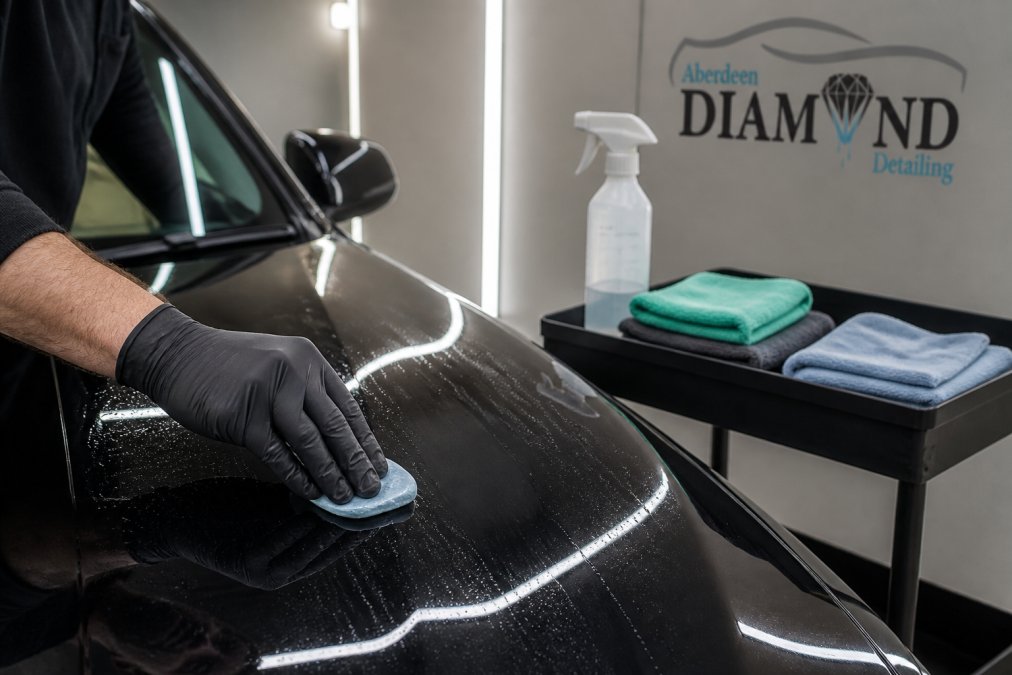
Trade buyers and private purchasers both read swirl marks, stone chips, and faded trim as evidence of neglect. That perception gives them room to negotiate, and it is far cheaper to prevent than to reverse.
Where detailing pays off is consistency. A single deep clean before sale rarely moves the price much. A car protected from new, and maintained properly, presents as a genuine low-mileage example even at high mileage.
Resale value is built over years, not weekends. Regular protection preserves the finish so that when you do sell, the paint tells a story of care rather than a story of car washes.
Ceramic Coating Benefits for Resale: What Buyers Notice
The main ceramic coating benefits for resale come down to three things: gloss retention, easier cleaning, and evidence of protection. Buyers notice all three, even if they cannot name the product.
A ceramic coating is a liquid polymer that bonds to the clear coat and forms a semi-permanent protective layer. It makes washing easier, reduces the bond of contaminants, and holds gloss far longer than wax.
What most guides miss is that the coating’s real value is diagnostic. A buyer inspecting a coated car can see that the previous owner invested in protection, which is a proxy for how the mechanicals were treated.
Where it falls short: a coating is not a shield against stone chips, and it does not repair existing defects. It locks in whatever finish sits beneath it.
Paint Protection Film Cost vs Value: A Practical Breakdown
The paint protection film cost versus value question has a straightforward answer: PPF costs more upfront than a coating, but it delivers physical impact resistance that a coating cannot.
Paint protection film is a transparent urethane layer applied to high-risk panels, usually the front bumper, bonnet, wings, and mirrors. It absorbs stone strikes and road debris.
Value depends entirely on the car. On a prestige or performance vehicle, PPF protects the most expensive panels to repaint and the ones a buyer inspects first. On a high-volume hatchback, the maths is tighter.
Pricing for both PPF and ceramic coating depends on vehicle size, panel coverage, and paint condition. For current pricing, check our website or request a quote.
Detailing vs Valeting for Car Sales: Why the Difference Matters
Detailing versus valeting for car sales is not a marketing distinction. It is the difference between a clean car and a corrected car, and buyers can tell.
What a Standard Valet Covers
A valet is a thorough clean: wash, wheels, glass, vacuum, interior wipe-down, and trim dressing. It takes a few hours and makes a car presentable for photographs and viewings. It does not touch the paint’s surface defects.
Where Professional Detailing Goes Further
Detailing adds machine paint correction, decontamination, and protective coating. It removes swirl marks rather than hiding them under fillers, and it protects the finish so it stays that way.
| Aspect | Standard Valet | Professional Detailing |
|---|---|---|
| Primary goal | Presentable for sale | Restore and protect finish |
| Paint correction | None | Machine polishing |
| Decontamination | Basic wash | Iron, tar, clay treatment |
| Protection applied | Wax or dressing | Ceramic coating or PPF |
| Typical duration | A few hours | One to several days |
| Best for | Quick sale prep | Long-term value retention |
A valet helps a car sell. A detail helps a car sell for more, and protects the investment in the meantime.
Typical Detailing Service Costs and How to Judge ROI
Detailing service costs vary widely because scope varies, so judging ROI means comparing spend against the value protected, not against a fixed price list.
A common mistake is treating the cheapest quote as the best value. Low quotes usually mean no paint correction, short-life products, or insufficient time allocated to decontamination.
To judge return, compare three numbers: the cost of the work, the cost of repainting the panels it protects, and the expected price difference at sale. If a front-end PPF application costs less than a respray of the bonnet and bumper, the case is straightforward.
Ask any detailer what products they use, how long the protection lasts, and what happens if something goes wrong.
Common Mistakes That Undermine Your Resale Return
Several mistakes quietly destroy the return on detailing, and most of them happen before the car ever reaches a studio.
The first is automated car washes. Brush rollers grind grit into the clear coat and create the swirl marks that paint correction later has to remove.
The second is sealing over defects. Applying a coating or film without correcting the paint first traps swirls and scratches permanently beneath the protection.
The third is inconsistent maintenance. A coated car still needs careful washing with the right technique. Poor washing after protection shortens its life and dulls the finish.
Applying paint protection film over uncorrected paint locks existing swirl marks in place. Removing the film to fix them later risks damage to the clear coat, so the correction must happen first.
Conclusion: When Detailing Pays Off and When It Doesn’t
Detailing pays off when the car is worth protecting and you intend to keep it long enough for the protection to work. It pays off less when the vehicle is near the end of its life or the finish is already beyond economical correction.
For prestige, performance, and new vehicles, the case is strong: PPF and ceramic coating preserve the finish that buyers pay a premium for, and they make maintenance simpler along the way.
For older, high-mileage cars, a thorough valet and a careful maintenance routine often deliver most of the benefit at a fraction of the cost. The honest answer is that detailing is an investment in condition, and condition is what the market actually pays for.
Frequently Asked Questions
Does ceramic coating increase car resale value?
Ceramic coating can support resale value by protecting the paintwork and making the car easier to clean, which helps it present better at sale time. Buyers of prestige and performance vehicles often view a coated car as better maintained. However, the coating itself doesn’t add a fixed sum to the price. Its value lies in preserving the finish so the car looks closer to showroom condition, which can make it more attractive to buyers comparing similar models.
How much does professional detailing improve a car’s trade-in price?
There is no guaranteed figure, but a professionally detailed car typically presents better than one with swirl marks, faded trim, or ingrained dirt. Dealers and private buyers factor appearance into their offer. The improvement depends on the car’s base condition, age, and market demand. A full paint correction and protection package on a prestige vehicle is more likely to influence the price than a basic clean on an older hatchback.
Is paint correction worth the cost before selling a car?
Paint correction removes swirl marks, light scratches, and oxidation that make a car look older than it is. If your paintwork has visible defects, correction before sale can help the car photograph better and stand out in listings. If the paint is already in good condition, a protection layer may be enough. The key is matching the level of work to the car’s actual condition and its likely buyer.
How does paint protection film affect long-term vehicle value?
Paint protection film shields high-impact areas from stone chips, road debris, and minor scuffs. On prestige and performance cars, intact original paint is a significant selling point. PPF helps preserve that originality, which buyers and dealers value. The cost vs value question depends on how long you keep the car and how exposed it is to motorway driving and harsh weather. For many owners, the protection outweighs the expense over several years of ownership.