Table of Contents
- Protects Vehicle Finish vs Maintains New Car Shine: What’s the Difference?
- Paint Correction vs Ceramic Coating for New Cars: Which Solves Swirl Marks?
- DIY Swirl Removal Products: What Actually Works
- Professional Paint Correction Cost: What Affects the Price
- How to Prevent Swirl Marks on New Paint
- Which Approach Protects Your Vehicle Finish Long-Term?
- Conclusion
- Frequently Asked Questions
Last Updated: September 16, 2026
Protects Vehicle Finish vs Maintains New Car Shine: What’s the Difference?
Most owners treat “protecting the finish” and “keeping the shine” as the same job. They are not, and confusing them is why so many new cars end up covered in swirl marks within a year. Protecting vehicle finish means stopping damage before it reaches the clear coat: physical barriers, careful wash technique, and coatings that resist contamination. Maintaining new car shine means preserving the visual depth and gloss you drove away with. One is defence; the other is presentation. You need both, but they demand different methods, and swirl mark removal sits at the point where the two collide.
At Aberdeen Diamond Detailing, we see the result of that confusion constantly: owners who polish obsessively to chase gloss, then wonder why fresh marring appears within weeks. The answer is almost always technique and protection, not effort.
Protection prevents new swirl marks from forming. Shine maintenance removes nothing. If your paint is already marred, neither approach fixes it on its own.
Paint Correction vs Ceramic Coating for New Cars: Which Solves Swirl Marks?
Paint correction solves swirl marks. Ceramic coating does not, and no coating applied over marred paint will hide them. This is the single most misunderstood point in new car care.
Paint correction is the machine polishing process that removes a thin layer of clear coat to eliminate defects permanently. Ceramic coating is a liquid polymer that bonds to the paint surface and adds hydrophobic protection, chemical resistance, and gloss. It preserves the finish you have; it cannot restore one you have lost.
For a new car with light swirl marks, the correct order is correction first, then protection. Skipping the correction step locks the defects under the coating, where they stay visible for the life of the layer.
That said, not every new car needs correction. A car that has been washed carefully since delivery often needs only a light single-stage polish, or none at all. A professional assessment with a paint depth gauge tells you which category you fall into before anyone touches a machine.
DIY Swirl Removal Products: What Actually Works
DIY swirl removal works, but only with realistic expectations. Hand application removes light marring; anything deeper needs a dual-action polisher and patience.
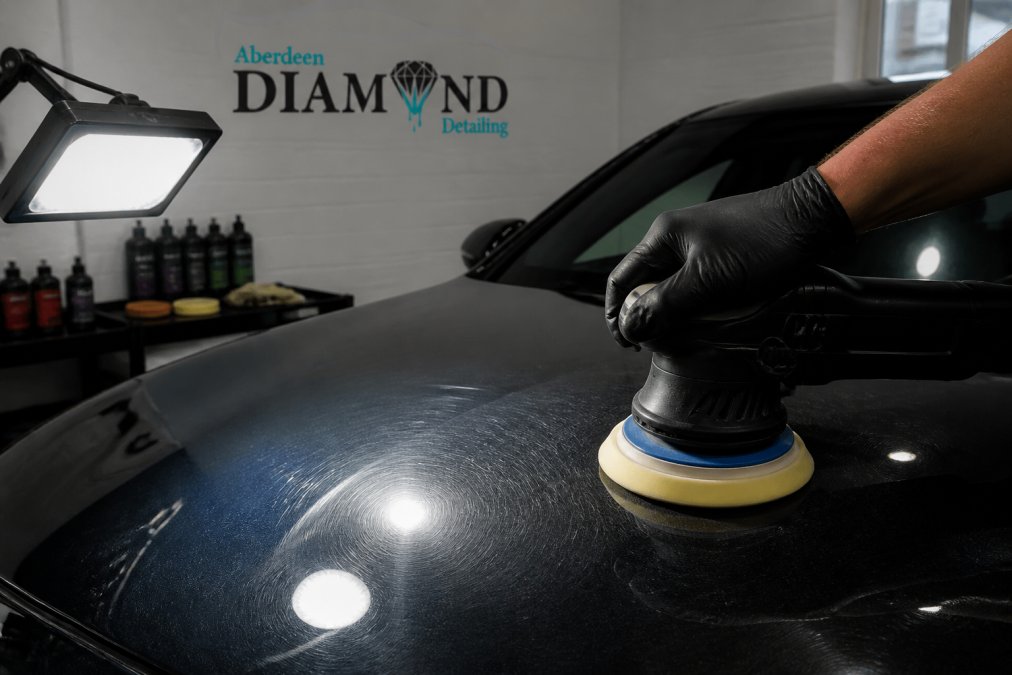
Three products worth knowing:
- Meguiar’s Ultimate Compound (around £15-£20) uses micro-abrasive technology to remove light scratches and oxidation. It is clear coat safe and widely stocked, but it rewards effort: hand application is slow, and a dual-action polisher gets far better results.
- Turtle Wax Hybrid Solutions Ceramic Polish & Wax (around £18-£22) combines light polishing with SiO2 protection in one step. Ideal for maintenance-level correction, though it will not touch deep scratches.
- Jax Wax Professional Swirl Remover (around £20-£25) is a filler-free abrasive, meaning it genuinely removes defects rather than masking them with oils. It leaves no protection behind, so you must follow with a wax or sealant.
Filler-heavy “swirl removers” hide defects with oils that wash away after a few weeks. The swirls return, and you have spent an afternoon for nothing. Check whether a product is filler-free before buying.
The honest limitation: DIY correction on a prestige or dark-coloured car carries real risk. Clear coat is thin, and an inexperienced hand on a machine can burn through it. If your paint is original and you value it, that risk is the argument for professional work.
Professional Paint Correction Cost: What Affects the Price
Professional paint correction cost depends on paint condition, vehicle size, and how many polishing stages are required, not on a flat rate. A light single-stage enhancement on a well-kept car sits at the lower end. A multi-stage correction on a swirled, neglected finish takes considerably longer and costs accordingly.
Four factors drive the figure:
| Factor | What It Changes | Impact on Cost |
|---|---|---|
| Paint condition | Severity of swirls and scratches | More stages needed |
| Vehicle size | Panel area to polish | More time per stage |
| Stages required | One-stage vs multi-stage | Each stage adds labour |
| Protection added | Coating or PPF after correction | Additional materials and time |
Pricing depends on your vehicle’s assessment, so we quote after inspecting the paint rather than guessing over the phone. Paint depth readings, panel count, and the level of finish you want all shape the final figure.
How to Prevent Swirl Marks on New Paint
Preventing swirl marks on new paint comes down to three habits: touch it less, clean your tools, and never let a wash mitt touch a dry panel.
Swirl marks are almost always wash-induced. Grit trapped in a sponge or mitt drags across the surface and leaves fine circular scratches that show up in direct sunlight. The fix is a method, not a product.
- Use the two-bucket method: one bucket for shampoo, one for rinsing your mitt
- Fit a grit guard to the rinse bucket to trap debris at the bottom
- Rinse the car with a pressure washer before any contact
- Work top-down, panel by panel, rinsing the mitt between sections
- Dry with a clean plush microfibre towel or filtered blower, never a chamois
- Never wash in direct sun or on a hot bonnet
- Avoid automatic brush washes entirely
The safest long-term move on a new car is to have protection applied before the first wash. A coating or paint protection film means fewer contact washes and a surface that releases dirt more easily, so the swirls never get a chance to start.
Which Approach Protects Your Vehicle Finish Long-Term?
The approach that protects your vehicle finish long-term is correction followed by durable protection, then disciplined maintenance. No single product does all three jobs.
Here is how the options compare for a new car with light swirl marks:
| Approach | Removes Swirls | Adds Protection | Best For |
|---|---|---|---|
| DIY polish and wax | Light marring only | Short-term | Kept cars, light upkeep |
| Ceramic coating alone | No | Long-term | Already-corrected paint |
| Paint protection film | No | Physical barrier | High-impact panels |
| Professional correction plus coating | Yes, permanently | Long-term | Prestige and performance cars |
The mistake most owners make is buying protection before the paint is ready for it. Coating a swirled car seals in the problem. Correcting first, then protecting, is the sequence that delivers both a flawless finish and lasting defence against road debris and harsh weather.
Aberdeen Diamond Detailing specialises in paint protection film and ceramic coating, with paint correction carried out before any protective layer goes on. That order matters more than the brand of product you choose.
Conclusion
Swirl mark removal is a correction job, not a protection job, and separating the two is what keeps a new car looking new. Protect the finish to stop damage occurring; correct the paint when it already has. If your car has light marring, a careful DIY polish may be enough. If it is a prestige or performance vehicle with original paint, professional assessment and correction before coating is the safer route. Get the sequence right and the shine takes care of itself.
Frequently Asked Questions
What is the difference between paint protection and swirl mark removal?
Paint protection, such as ceramic coating or paint protection film, creates a barrier over your clear coat to shield it from contaminants and minor abrasions. Swirl mark removal, by contrast, uses machine polishing to level the clear coat and eliminate existing defects. Protection prevents future damage but does not remove swirls already present. For best results, paint correction should be performed first, then a protective layer applied to maintain the finish.
Does a ceramic coating prevent swirl marks?
A ceramic coating adds a sacrificial layer that resists light contact damage, but it does not make paint scratch-proof. Improper washing, automatic car washes, and abrasive contact can still mar the surface. Coatings do make maintenance easier because dirt releases more readily, reducing the need for aggressive washing. Combining a coating with careful hand-washing technique offers the best protection against swirl marks on new paint.
Can I remove swirl marks without professional paint correction?
Yes, for light swirl marks you can use a dual-action polisher with a fine abrasive compound such as Meguiar’s Ultimate Compound or a dedicated swirl remover. These products cost between £15 and £25 and are widely available. However, deep defects or extensive marring require multi-stage machine polishing that only a professional service can safely deliver without risking clear coat damage.
How often should I perform paint correction on a new vehicle?
Paint correction is not a routine maintenance task. It should be performed when swirl marks or defects become noticeable, typically every two to four years depending on wash technique and environmental exposure. Over-polishing thins the clear coat, so it should only be done when necessary. Maintaining a protective layer and using proper wash methods will extend the interval between corrections.
Why do automatic car washes cause swirl marks?
Automatic car washes use spinning brushes or cloth strips that trap grit and drag it across the paint surface. Each pass creates fine circular scratches, known as swirl marks, that dull the finish under sunlight. Over time, repeated use causes significant marring that requires machine polishing to remove. Hand-washing with the two-bucket method and a grit guard is far safer for your vehicle finish.