
Table of Contents
- Professional Paint Correction vs Cheaper Alternatives: What You Pay For
- Paint Correction vs Ceramic Coating for New Cars: Do You Need Both?
- How Long Does Paint Correction Take? A Realistic Timeline
- Paint Correction Stages Explained: From One Stage to Multi-Stage
- When Professional Paint Correction Is Worth It
- When You Should Skip Professional Paint Correction
- The Verdict: Is Professional Paint Correction Worth It for Your Car?
- Frequently Asked Questions
Last Updated: September 8, 2026
The question of whether professional paint correction is worth it usually comes down to one misunderstanding: people think it is a luxury cosmetic upgrade rather than essential maintenance. Paint correction is the controlled removal of a microscopic layer of clear coat to eliminate swirl marks, oxidation, and light scratches. A professional finish transforms both appearance and resale value. Below, we’ll show you exactly how to decide if the process is right for your car, what it costs in time, and when you should skip it entirely.
Professional Paint Correction vs Cheaper Alternatives: What You Pay For
The core difference between professional paint correction and cheaper alternatives comes down to risk and results. A hand-applied polish or a quick machine pass from a valeting service might improve gloss temporarily, but it often leaves holograms and deeper marring behind.
Professional correction uses multi-stage machine polishing with paint depth measurement to ensure safe clear coat removal. DIY kits, even with a dual-action polisher, carry a genuine risk of burning through the clear coat on edges and panel creases. The guidance on paint correction safety from Detailed Image stresses that inexperience is the leading cause of clear coat damage.
What you pay for with a professional is the measurement, the staging, and the insurance that your paint is being removed evenly.
A common mistake is assuming a “cut and polish” from a general valeter equals paint correction. Without paint depth gauges, they are guessing how much clear coat remains, which can lead to thin or burnt paint on high points.
Paint Correction vs Ceramic Coating for New Cars: Do You Need Both?
For new cars, paint correction and ceramic coating serve different purposes, but they work as a sequence rather than competing options. Paint correction restores the surface to a flawless state; ceramic coating locks in that finish with a durable, hydrophobic layer.
New cars often arrive with swirl marks from dealership prep or transport. Applying ceramic coating over an uncorrected surface permanently seals in those defects. Professional guidance, such as the ceramic coating application notes from Gtechniq, confirms that a perfectly corrected surface is required for optimal bonding and gloss.
If your new car is already flawless, you can skip correction and apply coating directly. If you can see swirls under bright light, correction comes first, then protection.
How Long Does Paint Correction Take? A Realistic Timeline
A realistic timeline for professional paint correction ranges from one full day for a light one-stage polish to three or more days for a multi-stage correction on a larger vehicle. The process is not a quick service; it is labour-intensive and methodical.
Here is what affects the timeline:
- Paint hardness: European and modern water-based paints often require more passes.
- Condition: Heavy oxidation or deep scratches add significant time.
- Vehicle size: A large SUV takes considerably longer than a sports car.
- Coating application: Adding ceramic coating or PPF afterwards adds a full day for curing.
Many owners are surprised that a proper job cannot be rushed. If a detailer quotes a full correction in four hours, they are either using aggressive cutting compounds that risk the clear coat or they are not correcting properly.
Paint Correction Stages Explained: From One Stage to Multi-Stage
Paint correction stages are categorised by the number of polishing steps performed, each using progressively finer abrasives. A one-stage correction removes light swirls and oxidation using a single polish. A two-stage correction adds a finer finishing polish after the cutting stage to refine the gloss. Multi-stage correction, often three or more stages, is reserved for severe defects and show-quality finishes.
Choosing the right stage depends on your paint’s condition and your goal. If your car has minor swirl marks from improper washing, a one-stage correction will transform it. If you are preparing a prestige vehicle for ceramic coating or paint protection film, a two-stage correction ensures the surface is perfect before the protection is applied.
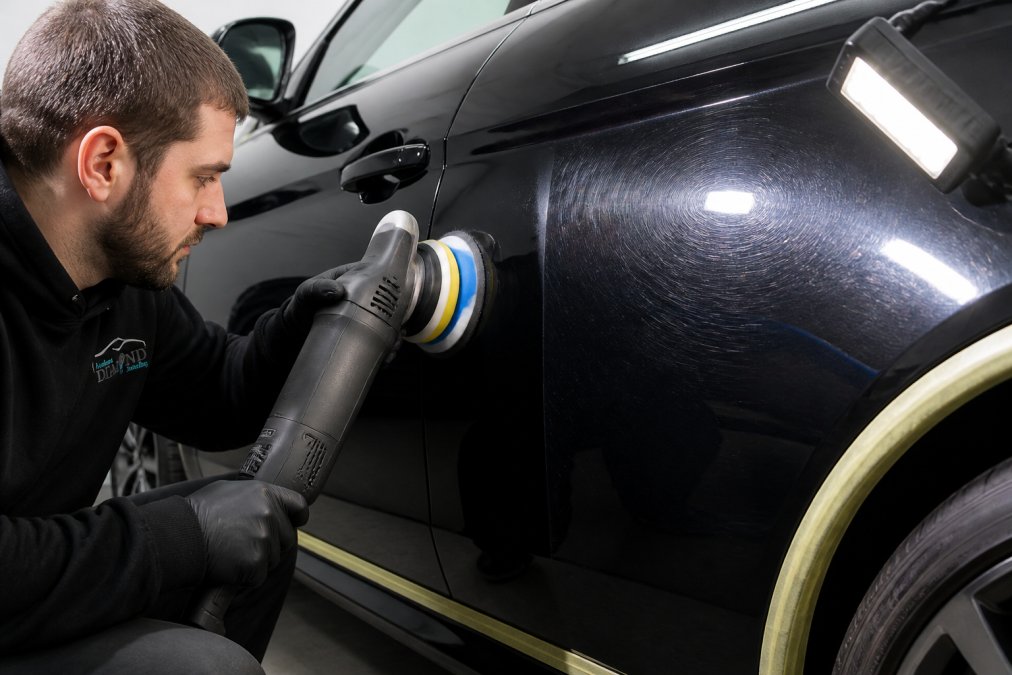
Ask your detailer for a paint depth reading before and after the process. A professional will measure the clear coat to confirm how much material is safely available and document the removal. If they cannot show you these numbers, find someone who can.
When Professional Paint Correction Is Worth It
Professional paint correction is worth it when you plan to keep the vehicle for several years, when you are preparing it for a protective coating, or when you are selling and want to maximise the price. These three scenarios justify the investment because the correction either protects your asset or pays for itself.
For owners of prestige and performance vehicles, correction is non-negotiable before applying paint protection film or ceramic coating. The film or coating will last for years, but it will permanently showcase every swirl mark underneath. For new car owners, correcting dealership-installed defects early prevents them from becoming embedded and more costly to remove later.
| Scenario | Recommendation | Why |
|---|---|---|
| Prestige vehicle, preparing for PPF | Full multi-stage correction | Film locks in defects permanently |
| New car with dealer swirls | One or two-stage correction | Cheaper now than later |
| Selling a car privately | One-stage correction | Removes buyer objections on swirls |
| Daily driver, light swirls | One-stage correction | Restores gloss and protects value |
| Garage queen, never driven | Skip correction | No defects to remove |
When You Should Skip Professional Paint Correction
You should skip professional paint correction if the paint is too thin to safely polish, if the vehicle is a high-mileage daily driver with deep stone chips that require repainting, or if you plan to sell a car that is already in poor condition. In these cases, the money is better spent elsewhere.
Paint depth measurement determines whether correction is safe (autogeek.net). If the clear coat is already thin from previous polishing, further correction risks exposing the base coat. A vehicle with heavy bird dropping etching or acid rain damage may need a respray rather than a polish.
For a car that is garaged and washed carefully, you may never need correction. Careful maintenance prevents swirls from forming, which means the paint retains its original finish. If you are diligent with proper washing techniques, you can preserve the factory finish and skip correction entirely.
The Verdict: Is Professional Paint Correction Worth It for Your Car?
Professional paint correction is worth it for any vehicle where the finish matters, whether for pride of ownership, protection, or resale value. It is not worth it for vehicles with irreparable paint damage or for owners who will not maintain the corrected finish with proper washing.
The deciding factor is your paint’s condition and your plans for the car. If the clear coat is healthy and you want a flawless, protected finish, correction is the only way to achieve it. Aberdeen Diamond Detailing specialises in multi-stage paint correction for prestige and performance vehicles, integrating the process with paint protection film and ceramic coating applications.
Frequently Asked Questions
Does paint correction remove too much clear coat?
Professional paint correction removes a microscopic layer of clear coat, typically measured in microns. Detailers use paint depth gauges before starting to ensure they never cut deeper than is safe. The clear coat on modern cars is roughly 40-50 microns thick, and a single stage of correction usually removes only 2-5 microns. This leaves ample clear coat for years of protection, provided the work is done by an experienced professional rather than an enthusiastic amateur.
Is paint correction worth it on a brand new car?
Often, yes. New cars frequently arrive from the factory or dealership with swirl marks, holograms, and minor imperfections from automated washing. Correcting these before applying a ceramic coating locks in a flawless finish. If you plan to keep the car for several years or care about its resale value, paying for paint correction on a new car protects your investment from day one and ensures the coating bonds to a perfectly smooth surface.
How long does professional paint correction last?
The correction itself is permanent in that the removed defects will not return. However, new swirl marks will appear over time from washing, weather, and road debris. A professional ceramic coating applied after correction will help protect the finish and make it easier to clean, extending the flawless look for up to five years. Without protection, you may need another correction session within two to three years depending on how you maintain the car.
What is the difference between machine polishing and paint correction?
Machine polishing is the process of using an abrasive compound and a polisher to remove defects. Paint correction is the systematic, staged approach to that process, involving paint depth measurement, defect assessment, and progressively finer polishing stages to achieve a flawless result. A quick machine polish might just remove light oxidation. Proper paint correction addresses swirl marks, scratches, and haze methodically, which is why it takes longer and costs more.
Can paint correction fix deep scratches and stone chips?
Paint correction can remove scratches that are confined to the clear coat layer. If you can catch a fingernail in the scratch, it has likely penetrated through to the base coat or primer, and polishing will not fix it. Stone chips fall into this category as well. For these defects, you would need a touch-up repair or respray. A professional detailing service will assess your paintwork honestly and tell you what correction can achieve.
Getting the finish right comes down to honest assessment of your paint and your goals. If you are ready to restore your vehicle to a showroom-quality finish and protect it against the harsh Scottish climate, contact Aberdeen Diamond Detailing for a consultation. We will measure your paint, recommend the correct stage, and show you exactly what is possible before we begin.