Table of Contents
- Swirl Mark Removal: Two Goals, One Finish
- Quick Comparison: Flawless Looks vs Long-Term Protection
- Paint Correction vs Ceramic Coating for New Cars
- How to Prevent Swirl Marks After Paint Correction
- The Cost of Paint Correction Services and What Drives It
- Where Each Approach Wins: Scenario-Based Recommendations
- Conclusion
- Frequently Asked Questions
Last Updated: September 12, 2026
Swirl Mark Removal: Two Goals, One Finish
Swirl mark removal sits at the centre of two very different ambitions: making a car look flawless today, and protecting its finish for years to come. At Aberdeen Diamond Detailing, we see this tension every week. A car can leave the unit with a mirror finish and still pick up fresh swirl marks within months if nothing is done to protect the paint afterwards. That is why the real question is not “looks or protection” but which goal you are optimising for, and what combination of correction and protection actually delivers it.
Swirl marks are fine circular scratches in the clear coat, usually caused by improper washing and drying rather than by driving. They scatter light, which is why they show up as a dull, cobwebbed haze under sunlight or garage lighting.
Below, we break down how each approach works, what drives the cost of paint correction, and which one suits your car and your habits.
Quick Comparison: Flawless Looks vs Long-Term Protection
Flawless looks come from paint correction; long-term protection comes from a coating or film. They solve different problems, and most owners eventually need both.
| Goal | Primary Method | What It Fixes | Durability | Best For |
|---|---|---|---|---|
| Flawless appearance | Machine polishing | Existing swirl marks and haze | Until next wash cycle | Cars with visible defects |
| Long-term protection | Ceramic coating or PPF | Future swirls, chips, UV | Years with correct care | New or freshly corrected cars |
| Both | Correction then protection | Defects plus prevention | Longest window | Prestige and performance cars |
The distinction matters because polishing removes a thin layer of clear coat, while protection adds a sacrificial layer on top. One is subtractive, the other additive. Treating them as interchangeable is the most common mistake we see.
Paint Correction vs Ceramic Coating for New Cars
Paint correction vs ceramic coating for new cars is not really a contest, because the two do opposite jobs. Correction removes defects already in the paint. A ceramic coating bonds to the surface and protects what is underneath.
A new car often arrives with transport marks, dealer wash swirls, or light marring from storage. Correction removes those. A coating then locks in the corrected finish and makes future washing safer, because dirt releases more easily from a slick surface.
Here is the honest limitation: a coating will not hide swirl marks. If you coat over uncorrected paint, you seal the defects in. For most new cars, a light single-stage polish followed by a coating gives the best balance of gloss and durability. Owners who want a physical barrier against stone chips should look at paint protection film instead, which is a different product with a different purpose.
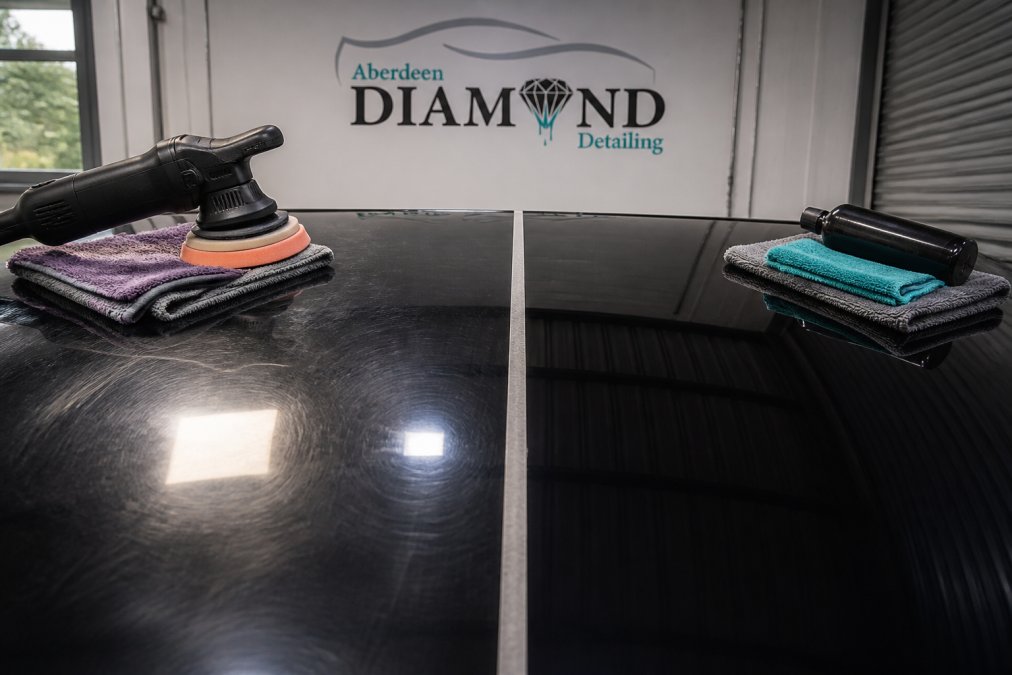
Ask any detailer to show you the paint under a swirl-finding light before and after correction. If they cannot demonstrate the difference on your own bonnet, you are paying for a wash, not a correction.
How to Prevent Swirl Marks After Paint Correction
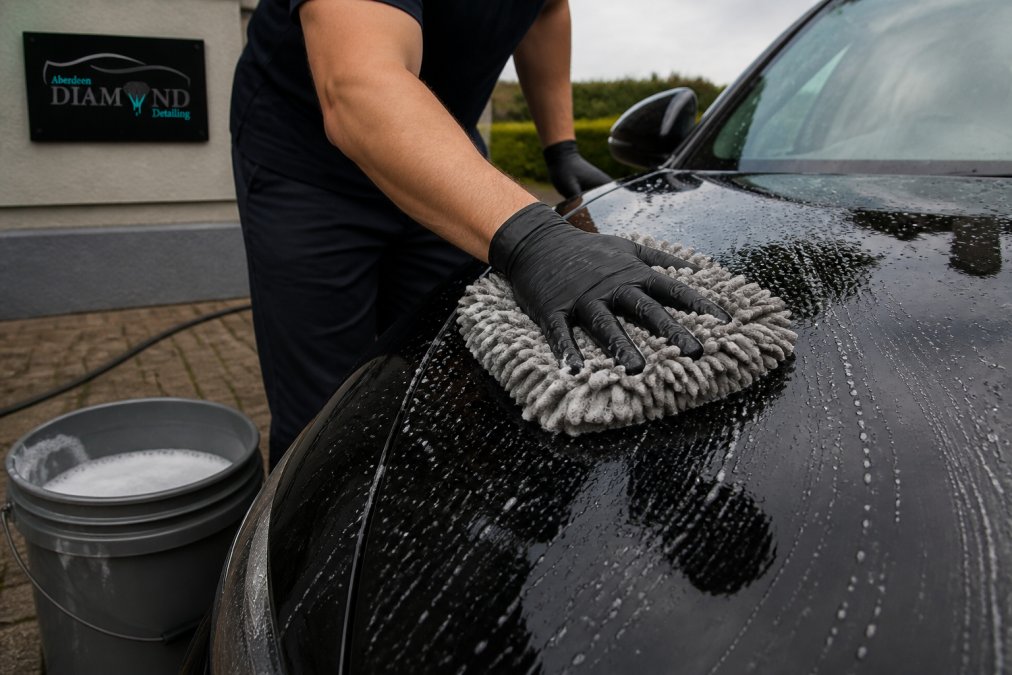
Prevention after correction comes down to washing technique, because almost all swirl marks are inflicted, not acquired. Correct your wash process and the finish stays sharp for far longer.
Here is the routine we recommend:
- Use the two-bucket method: one bucket of shampoo, one of rinse water, with a grit guard in each
- Pre-rinse with a pressure washer to lift loose grit before touching the paint
- Wash top-down, starting with the roof and finishing with the sills
- Use a plush microfibre wash mitt, never a sponge or brush
- Dry with a clean microfibre towel or filtered blower, not a chamois
- Never wash in direct sun or on a hot panel
- Avoid automatic brush car washes entirely
Scottish weather adds its own pressure. Road salt, grit, and constant damp mean more frequent washing, and more frequent washing means more chances to introduce swirls. A protected surface reduces that risk because dirt lifts away with less contact.
The Cost of Paint Correction Services and What Drives It
The cost of paint correction services depends on paint condition, vehicle size, and how much clear coat must be removed. There is no single figure that applies across the board.
Several variables push the price up or down:
- Severity of defects: light swirls need one polishing stage; deeper marring may need two or three
- Paint hardness: some manufacturers use softer clear coats that correct quickly, others resist abrasion
- Vehicle size and panel count: a large SUV or a van takes considerably longer than a hatchback
- Trim and delicate areas: spoilers, gloss black pillars, and wrapped panels add labour
- Paint thickness: a gauge reading tells the detailer how much clear coat is safe to work with
Pricing for correction, coatings, and film at Aberdeen Diamond Detailing depends on the vehicle and its condition, so the only accurate route is a quote after inspection. For reference, a professional finishing polish such as Menzerna Super Finish 3500 retails around £18.95, which shows how little of a correction bill is product cost. The rest is labour, equipment, and the skill to remove defects without burning through the clear coat.
Correction removes clear coat permanently. A car can only be corrected a limited number of times before the paint is compromised. If a quote seems unusually cheap, ask how much paint they intend to remove.
Where Each Approach Wins: Scenario-Based Recommendations
Each approach wins in a specific scenario, and matching the method to the situation is what separates a good result from an expensive one.
Choose flawless looks first if your car has visible swirl marks under sunlight and you want them gone now. A machine polish with a fine-cut compound delivers the deepest immediate transformation. A finishing polish such as Menzerna Super Finish 3500 is designed for exactly this: removing light swirls with minimal paint removal.
Choose long-term protection if your paint is already in good condition and you want to keep it that way. A ceramic coating or paint protection film preserves the finish and makes maintenance easier. Self-healing films such as XPEL Ultimate Plus are built to shrug off light surface scratches and stone chips.
Choose both if you own a prestige or performance car and intend to keep it. Correct once, protect properly, then maintain. This is the approach that holds value best, because a documented, protected finish is easier to present at resale.
For owners who prefer to handle sealing themselves between professional visits, a polymer sealant like Meguiar’s Ultimate Liquid Wax offers an affordable middle ground, though it will not match the durability of a professional coating.
Conclusion
The choice between chasing a flawless look and protecting the finish is a false one, because correction without protection simply resets the clock. Correct the paint once to remove what is there, then protect it so you are not paying for the same work again next year. Match the method to your car’s condition and how you actually use it, and the finish will hold far longer. Aberdeen Diamond Detailing specialises in paint protection film and ceramic coating alongside paint correction, so owners can address both goals in a single, considered process.
Frequently Asked Questions
Does ceramic coating actually prevent swirl marks?
Ceramic coating adds a hard, slick layer that makes wash-induced swirl marks less likely, but it does not make paint scratch-proof. Grit still causes fine marks if you wash with a dirty sponge or use automatic brushes. Combining a coating with careful two-bucket washing and microfibre drying is what really keeps swirl mark removal results intact. For physical protection against stone chips and deeper scratches, paint protection film is the stronger option.
What is the difference between paint correction and paint protection?
Paint correction removes existing swirl marks and defects by machine polishing the clear coat, so it changes how the paint looks now. Paint protection, such as ceramic coating or paint protection film, is applied afterwards to shield that corrected finish from new damage. They serve different purposes: correction is restorative, protection is preventative. Most professional detailers recommend doing correction first, then protecting the fresh surface.
Can you remove swirl marks without professional paint correction?
Light swirl marks can sometimes be reduced with a fine finishing polish and a dual-action polisher, but deeper marks need measured machine correction to avoid burning through the clear coat. Hand polishing rarely removes them completely. If you are unsure how much clear coat you have to work with, a professional assessment is safer than guessing. Paint correction services exist precisely because this step carries real risk when done without experience.
How do automatic car washes cause swirl marks on vehicle paint?
Automatic car washes use spinning brushes and reused water that trap grit against your paint. Each pass drags those particles across the surface, leaving the fine circular scratches known as swirl marks. They are most visible on dark colours in direct sunlight. Avoiding brush washes and using a touchless or hand wash method is one of the simplest ways to prevent swirl marks from returning after paint correction.
Is paint correction a permanent solution for swirl marks?
No. Paint correction removes the swirl marks present at the time, but it does not stop new ones forming. Every wash, wipe, or contact with abrasive material can add fresh marks. That is why correction is best paired with a protective layer such as ceramic coating or PPF, plus a safe wash routine. Think of it as resetting the finish, not sealing it against all future wear.