
Table of Contents
- Why Luxury Car Paint Needs More Than a Standard Wash
- Paint Protection Film Benefits for High-Value Vehicles
- Understanding Ceramic Coating Cost and What Affects It
- How to Maintain Ceramic Coating for Long-Lasting Protection
- Step-by-Step: How to Protect Luxury Car Paint in 2026
- Common Mistakes That Damage Luxury Car Paint
- Conclusion
- Frequently Asked Questions
Last Updated: September 22, 2026
Why Luxury Car Paint Needs More Than a Standard Wash
Luxury car paint is a multi-layer factory finish that costs significantly more to repair than the paint on an everyday vehicle, which is why knowing how to protect luxury car paint 2026 is a different discipline from routine cleaning. At Aberdeen Diamond Detailing, we see prestige vehicles arrive with etched water spots and stone-chip damage that a weekly wash never had a chance of preventing.
The reason is straightforward: a standard wash removes surface dirt but adds nothing back. It does not create a sacrificial barrier, and it does nothing about the two things that actually ruin a finish here in the north east: road salt and grit thrown up by other traffic, and the low winter sun that turns every unsealed droplet into a tiny magnifying glass.
Below, we break down how to protect luxury car paint in 2026, from film and coatings through to the maintenance routine that decides whether either one survives its first Scottish winter.
Washing a dirty panel in a circular motion is the single fastest way to create swirl marks. Always work top-down in straight lines with two buckets, one for shampoo and one for rinsing the mitt.
Paint Protection Film Benefits for High-Value Vehicles
Paint protection film benefits are largely about impact resistance rather than shine. PPF is a transparent urethane film applied to the most exposed panels, and its job is to absorb stone chips, scuffs and light abrasion before they reach the clearcoat underneath.
For a high-value vehicle, that matters because the front bumper, bonnet leading edge and mirror housings take the worst of what a road throws at them. A film can be replaced; original factory paint cannot be restored to factory condition once it is chipped. On a prestige car, keeping the original paint intact is one of the few things that genuinely protects resale value.
A common mistake is assuming film and coating do the same job. They do not. Film is armour. Coating is a chemical layer that makes the surface easier to clean and adds gloss and hydrophobicity. Most owners of high-value cars end up wanting both, with film on the impact zones and coating across the whole body.
Film quality shows up in the edges, not the middle. Ask to see how the installer wraps the film around panel edges and whether they remove badges and handles rather than cutting around them. Poor edge work is what lifts and traps dirt first.
Understanding Ceramic Coating Cost and What Affects It
Ceramic coating cost is driven by preparation, not by the bottle of coating itself. The coating is a relatively small part of the job; the labour sits in decontamination, machine polishing to remove existing defects, and the careful, dust-free application.
Four factors move the price more than anything else:
- Paint condition. Heavy swirl marks and oxidation need more correction time before any coating goes on.
- Vehicle size and panel complexity. A large SUV with curves, vents and a panoramic roof takes longer than a compact coupé.
- Coating specification. Consumer-grade products and professional-grade coatings differ in durability and in how they must be applied.
- Film coverage. If PPF is being fitted first, the coating is applied over the film, which changes the process.
We do not publish fixed figures, because quoting a coating price without seeing the paint is guesswork. The honest answer is that pricing depends on the vehicle and its current condition, and any detailer who quotes blind is either padding the number or planning to skip the preparation.
How to Maintain Ceramic Coating for Long-Lasting Protection
How to maintain ceramic coating comes down to three habits: correct washing, avoiding the wrong chemicals, and topping up the coating before it fails rather than after.
A coated car still gets dirty. The coating makes dirt release more easily and reduces how aggressively contamination bonds to the surface, but it is not self-cleaning. Wash it every two to three weeks with a pH-neutral shampoo, never a wash-and-wax product, which leaves a film that masks the coating’s behaviour. Skip automatic brush washes entirely; the bristles are abrasive and the recycled water carries grit.
Twice a year, decontaminate with a chemical fallout remover and a clay treatment if the surface feels rough. Then apply a coating-specific maintenance spray or topper. This is the step most owners skip, and it is the reason coatings appear to “fail” early when the coating itself is still intact underneath.
A coating does not remove the need to wash a car. It changes how easily the car comes clean and how long the finish stays sharp between washes. Neglect it and even a professional-grade coating will look tired within a couple of years.
Step-by-Step: How to Protect Luxury Car Paint in 2026
Protecting a prestige finish is a sequence, and the order matters. Skip a step and the layer above it will not bond or perform properly.
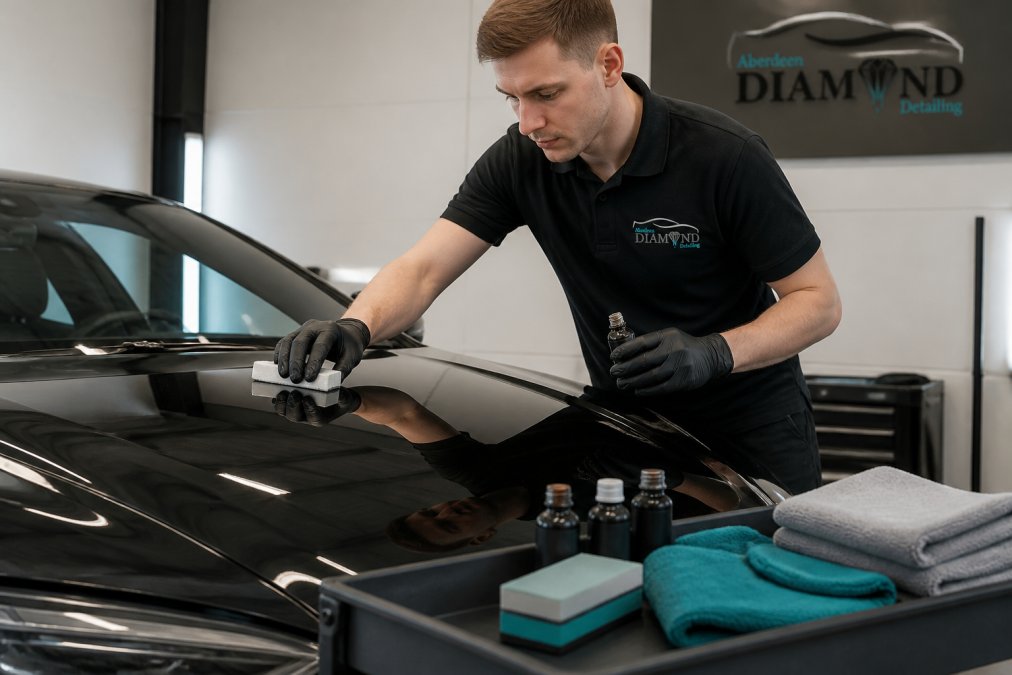
- Assess the paint under proper lighting. Inspect for swirl marks, stone chips and etching. This decides whether correction is needed before protection.
- Decontaminate. Wash, then remove bonded iron and tar, then clay the surface until it feels smooth.
- Correct the paint. Machine polish to remove defects. This is the step that creates the gloss; protection only locks in what is underneath.
- Panel wipe. Remove polishing oils so the coating or film has a clean surface to bond to.
- Apply film to impact zones. Front bumper, bonnet leading edge, mirrors and sills.
- Apply the coating. Work panel by panel in controlled conditions, levelling each section before it flashes.
- Cure and inspect. Allow the coating to cure undisturbed, then check under lighting for high spots or missed edges.
The whole process takes more than a day for most prestige vehicles, and the curing window afterwards matters as much as the application. Most coatings need the car kept dry and away from heavy contamination for the first week.
Common Mistakes That Damage Luxury Car Paint
The most damaging habits are the ones owners think are helping. Washing with a sponge, using a household detergent, or drying with a worn towel all introduce scratches that then need machine polishing to remove.
Other frequent errors:
- Washing in direct sunlight. The shampoo dries before it can be rinsed, leaving water spots that etch into the clearcoat.
- Using a brush wash or jet wash at close range. High-pressure water at the wrong angle can lift film edges and force water past seals.
- Letting bird droppings and tree sap sit. These are acidic and will mark a coating, and eventually the paint, within days.
- Skipping the maintenance topper. Coatings are a system, not a one-off event.
- Parking under trees or near building works. Fresh contamination bonds quickly and is harder to remove than road grime.
Never let a dealer or valeter “buff out” a scratch on a coated or filmed car without telling them what is on the paint. An aggressive compound can strip a coating or damage a film edge, undoing the protection you paid for.
Conclusion
Protecting a prestige finish is a system, not a single product: film on the impact zones, a professionally applied coating across the body, and a maintenance routine that keeps both working. The vehicles that still look sharp after several winters are the ones where the owner understood that preparation and upkeep matter more than the badge on the bottle. Get the sequence right, wash it properly, and the finish will hold its depth and its value for years.
Frequently Asked Questions
Is ceramic coating worth the cost for a luxury vehicle?
For a prestige or performance car, ceramic coating offers real value. It creates a hard, hydrophobic layer that makes washing easier, adds gloss, and shields against UV, bird droppings and road salt. The cost depends on the coating grade, paint condition and preparation required, so a car with swirl marks will need paint correction first. Rather than quote a fixed figure, it is best to request a tailored assessment based on your vehicle and how you use it.
What is the difference between paint protection film and ceramic coating?
Paint protection film is a thick, transparent urethane layer that absorbs physical impacts from stone chips, scuffs and light scratches. Ceramic coating is a liquid polymer that bonds to the paint, providing chemical resistance, hydrophobic behaviour and gloss, but it will not stop a stone chip. Many owners combine both: PPF on high-impact areas such as the bonnet and front bumper, then ceramic coating over the whole car for easier maintenance and added shine.
Does paint protection film prevent stone chips?
Yes, quality paint protection film is specifically designed to absorb the energy of stone chips and road debris. On a prestige car driven on motorways or rural roads, the front bumper, bonnet leading edge, wing mirrors and A-pillars take the worst of it. A self-healing top layer also removes light swirl marks when exposed to heat. Film will not make paint indestructible, but it dramatically reduces the chance of a chip reaching the clear coat.
How do environmental factors in the UK affect luxury car paint?
UK conditions are tough on paint. Road salt in winter accelerates corrosion on exposed edges, while tree sap, bird droppings and industrial fallout bond to clear coat and etch it if left. Frequent rain does not wash paint clean; it leaves mineral deposits that dull gloss over time. A combination of paint protection film on impact zones and a ceramic coating elsewhere gives the best defence, provided you maintain it with pH-neutral shampoo and avoid automatic brush washes.