Table of Contents
- Professional Ceramic Coating vs DIY Kits: What’s the Real Difference?
- Feature Comparison: Professional Application vs DIY Kits
- Ceramic Coating Durability: How Long Does Each Option Last?
- Ceramic Coating Cost: What Are You Actually Paying For?
- The Paint Correction Process: Why Preparation Decides the Finish
- Application Risks: What Happens When It Goes Wrong?
- Which Option Should You Choose?
- Frequently Asked Questions
Last Updated: September 6, 2026
Professional Ceramic Coating vs DIY Kits: What’s the Real Difference?
The debate between professional ceramic coating vs DIY kits usually comes down to one question: do you want a coating, or do you want a finish? Both approaches apply a liquid polymer that bonds to your paint, but the results diverge sharply on durability, appearance, and risk. At Aberdeen Diamond Detailing, we spend our days correcting paint and applying industry-grade coatings, so we see exactly what separates a DIY afternoon from a professional multi-stage installation.
The honest summary is that a professional ceramic coating is a guaranteed, long-term investment in your paintwork, while a DIY kit is a budget experiment with variable outcomes. That is not snobbery. It is chemistry and preparation. A ceramic coating is a sacrificial layer that bonds to your clearcoat to resist contaminants, UV damage, and wash-induced swirls. The difference is not the liquid in the bottle. It is what happens before it touches your panel.
Below, we will break down the real differences across durability, cost, preparation, and risk, so you can decide where your money is best spent.
Feature Comparison: Professional Application vs DIY Kits
Professional application often provides significant advantages for long-term paint protection. The gap starts with the product itself. Professional-grade coatings often use higher solids content and different resin chemistry than retail kits, which can translate directly into hardness and longevity.
| Feature | Professional Application | DIY Kit |
|---|---|---|
| Paint correction included | Yes, multi-stage | Rarely, minimal |
| Coating grade | Industry-grade, high-solids | Consumer-grade |
| Application environment | Controlled, dust-free | Your driveway or garage |
| Warranty backing | Professional-grade | None |
| Risk of high-spots | Near zero | High |
| Typical durability | 3-5 years plus | 1-3 years |
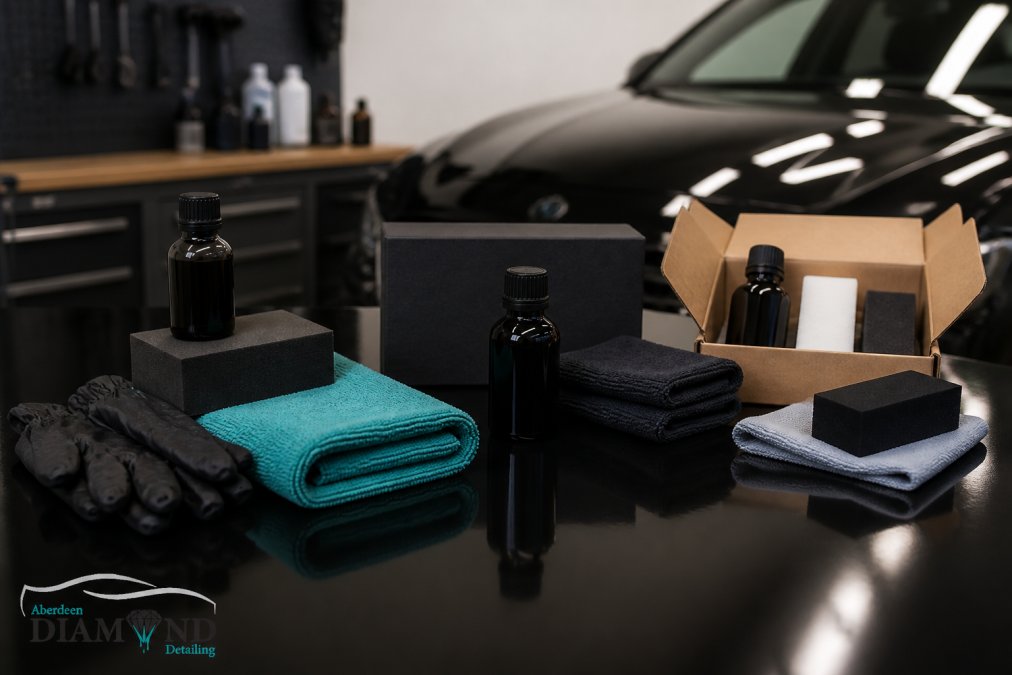
Consumer kits like Gtechniq Crystal Serum Light and Gyeon Q2 Mohs EVO are genuinely good products. Gtechniq offers up to 3-5 years of protection, and Gyeon claims up to 36 months (gtechniq.com). CarPro CQuartz UK 3.0 is formulated for cooler, damper climates, which suits the British weather well (carpro-us.com). The catch is application. These products demand meticulous surface preparation and a clean, indoor curing environment. Most owners do not have the space, lighting, or patience to achieve that.
Ceramic Coating Durability: How Long Does Each Option Last?
Professional ceramic coating durability can typically stretch to 3-5 years or more when the coating is applied to a perfectly prepared surface and cured in controlled conditions (peer-reviewed research). A DIY kit applied to paint that still has swirl marks and embedded contaminants will degrade faster, regardless of the brand.
The longevity of any coating depends on two factors: how well it bonds, and how well it is maintained. Bonding requires a surgically clean surface. Oils, silicone residue, or polish leftovers create a barrier that stops the coating from adhering properly. When that happens, the coating fails prematurely, often within months rather than years.
A common mistake is assuming a coating protects against everything. It does not. It resists UV damage, bird droppings, and road salt, and it makes washing easier because contaminants struggle to stick. But a coating will not stop a stone chip, and it will not hide existing swirl marks. It locks in whatever is underneath it. If you coat a scratched panel, you have preserved the scratches for years.
Ceramic Coating Cost: What Are You Actually Paying For?
The ceramic coating cost difference between a DIY kit and a professional installation is significant, but the comparison is misleading. A professional installation costs considerably more because you are paying for labour, expertise, and preparation, not just the liquid.
That preparation is the real expense. Paint correction is time-intensive. A skilled detailer removes swirl marks and defects using machine polishing, which takes hours and requires experience to avoid burning through the clearcoat. Skipping this step is why many DIY coatings fail or look underwhelming. The panel prep alone, including decontamination, clay barring, and IPA wiping, can take longer than the coating application itself.
Professional installation also includes a controlled environment. Dust and insects landing in a wet coating cause imperfections that are permanent. A garage or booth with proper lighting and airflow makes an enormous difference to the final finish. You are paying for the conditions as much as the skill.
The cheapest route is rarely the most economical. A failed DIY coating often requires a full machine polish to remove, which can be a significant expense. You can end up paying twice.
The Paint Correction Process: Why Preparation Decides the Finish
The paint correction process is the single biggest reason professional results outperform DIY kits. Paint correction removes surface defects like swirl marks, light scratches, and oxidation before the coating is applied. It is skilled, time-consuming work that directly determines how the final finish looks under light.
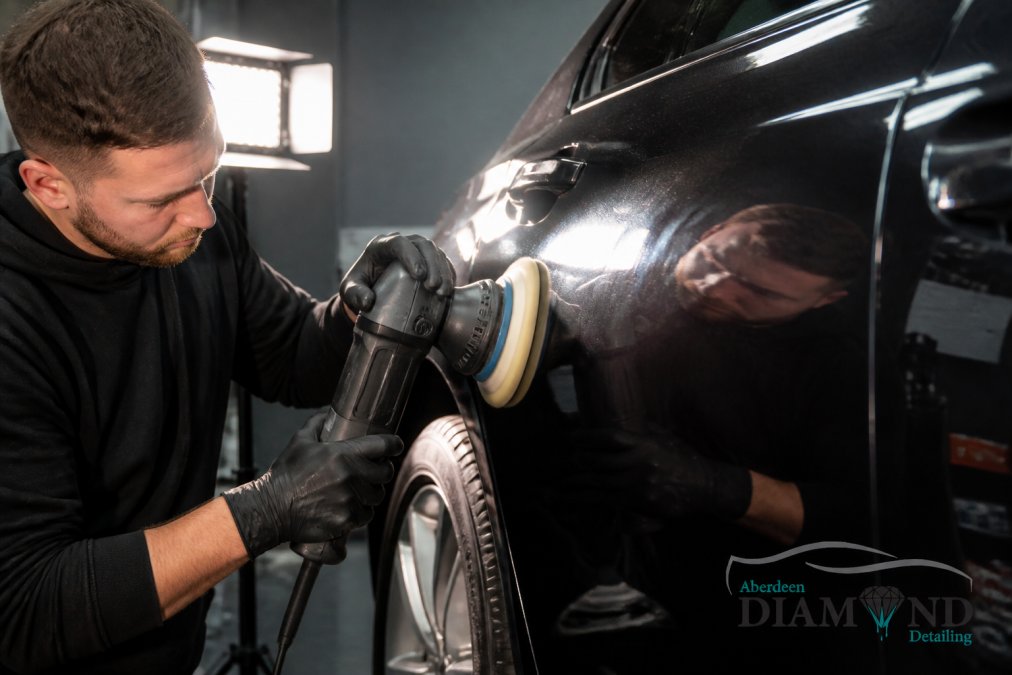
A detailer assesses the paint under bright lighting, selects the right pad and compound combination, and works panel by panel to level the clearcoat. This removes defects and creates a flat, highly reflective surface. When a ceramic coating is applied over that corrected paint, the gloss is amplified. When it is applied over swirled paint, the coating magnifies the defects.
For owners with a newer car with minor swirl marks, full correction may not be necessary. A lighter machine polish or finishing pass can be enough to prepare the surface. For older cars, or those that have seen automatic car washes, a more aggressive correction is usually required. The point is that the decision should be made by someone who can see the paint under proper lighting, not guessed at with a DIY kit.
Application Risks: What Happens When It Goes Wrong?
DIY application carries real risks that can damage your paint or require expensive corrective work. The most common failure is high-spotting, where the coating is not levelled evenly and leaves permanent, patchy marks in the paint. CarPro CQuartz UK 3.0, for example, is known to high-spot if not wiped off correctly during application.
Other risks include applying the coating too thickly, which causes uneven curing, or trapping dust and fibres under the layer. Coating a car outdoors in the British climate invites moisture issues, as many consumer coatings struggle to cure properly in damp conditions. Gyeon Q2 Mohs EVO explicitly requires a clean, indoor environment for curing.
There is also the risk of coating over defects. If you skip paint correction, you seal in every swirl mark and scratch. The coating makes them more visible, not less, because it adds a glass-like layer that refracts light differently.
A professional installation significantly reduces the risk of application errors. The detailer handles the correction, the environment, and the coating process, and the result is backed by a warranty.
Which Option Should You Choose?
Choose a professional ceramic coating if you own a prestige or performance vehicle, want a guaranteed finish, and plan to keep the car for several years. Choose a DIY kit if you are an enthusiast who enjoys the process, has a garage, and accepts the risk of a less durable result.
For most owners, the decision comes down to what the car is worth to you. A professional installation at Aberdeen Diamond Detailing includes multi-stage paint correction, application of industry-grade coatings, and a controlled environment. Our work covers paint protection film and ceramic coating applications alongside expert valeting, designed to keep prestige and performance vehicles looking flawless through harsh Scottish weather and road debris.
The DIY route is fine for a daily driver you are happy to maintain yourself. But if you want a showroom-quality finish that lasts, and you want to protect your vehicle’s market value, a professional installation can offer a high degree of certainty.
Frequently Asked Questions
How long does a professional ceramic coating last compared to a DIY kit?
Professional coatings can typically last five to nine years when maintained properly, because installers often use higher-solids products and prepare the paint thoroughly. Consumer DIY kits from brands like Gtechniq and CarPro offer between one and five years of protection depending on the specific product. The longevity gap comes down to surface preparation: a professional will correct paint defects before application, ensuring the coating bonds to a flawless surface, while DIY application over swirl marks or contamination will fail sooner.
Is it worth paying for a professional ceramic coating?
It depends on your priorities. A professional installation costs significantly more than a DIY kit, but that price includes multi-stage paint correction, a controlled environment, and the installer’s expertise. If you own a prestige or performance vehicle and want long-term protection without the risk of application errors, professional application can be a worthwhile investment. If you have a daily driver and are prepared to spend several hours on meticulous preparation, a quality DIY kit can still deliver solid results.
What are the risks of applying a ceramic coating yourself?
The most common DIY errors are high spots, uneven curing, and coating failure from inadequate surface preparation. High spots appear when the product is not levelled off quickly enough, leaving permanent marks that require machine polishing to remove. Applying ceramic coating over existing swirl marks or bonded contaminants seals those defects in. DIY kits also require a dust-free, indoor environment for up to 24 hours while the coating cures, which is difficult to achieve in a standard garage.
Does a professional ceramic coating require paint correction?
Yes, professional ceramic coating application always includes paint correction as part of the process. The coating bonds to the paint surface and will permanently lock in any existing swirl marks, scratches, or oxidation. Professional detailers perform a multi-stage machine polish to remove these defects before applying the coating. This preparation is the main reason professional results look superior to most DIY attempts, and it is a core part of the paint correction process that protects your vehicle’s finish.
The challenge is that paint is only original once. Every swirl mark you introduce, and every failed DIY coating you need removed, takes a layer of clearcoat with it. A professional ceramic coating protects that finite resource. At Aberdeen Diamond Detailing, we prepare and protect prestige and performance vehicles with paint correction and industry-grade coatings, ensuring your car retains its finish and its value. Contact us to discuss protecting your vehicle.